Preventing Spills, Leaks and Releases
Our objective is to prevent all liquids spills and leaks and natural gas releases and leaks. Following an incident, an investigation occurs to identify the layers of protection that failed, the causes and contributing factors so that corrective actions can be taken to strengthen our safety systems. Following are details on the recent overall performance of Enbridge’s three core businesses.
The integration of Spectra Energy has approximately doubled the asset base of Enbridge; which has had a corresponding effect on the number of incidents that occurred across the new Enbridge system, essentially doubling the number of process safety incidents in 2016 from 24 to 47 in 2017 (Tier 1 and Tier 2 incidents).
Definitions used in this section
For the purpose of our 2017 Sustainability Report, we include incidents that are significant and reportable to our Board of Directors. :
The harm done in a release (such as an injury or a fire) often dictates classification of an event at a higher tier than the volume released would. Similarly, our management may decide to upgrade how we classify any event—including those that did not result in any spills, releases or harm, but that were potentially serious—to a higher tier if they deem doing so to be prudent. As such, the incidents that we include in this report have not all resulted in a spill or release.
Liquids Systems
In 2017, we delivered more than 3.7 billion barrels of crude oil and natural gas liquids. We experienced 13 reportable spills on our liquids systems in Canada and the U.S., which compares with 8 in 2016 and 14 in 2015. The total volume from the spills in 2017 was 8,470 barrels, compared with 657 barrels in 2016 and 480 barrels in 2015. Based on the volumes spilled and our gross delivery volumes, we achieved a safe delivery rate of 99.9998 percent in 2017.
The increase in volume spilled is largely attributable to a significant incident that occurred in February 2017. A contractor working for a third party struck Enbridge’s Line 2A during a directional drilling operation. The incident resulted in the release of more than 6,000 barrels of condensate blend. The product was confined to the sub-surface and two large excavations that were present in support of the directional drilling operation. Response operations commenced immediately. No air quality risks were identified. Approximately 6,100 barrels of product was recovered, and contaminated soil was remediated through excavation and in-situ treatment.
Information on other significant incidents is included at the end of this section.
| Number of reportable liquids spills | Volume of reportable liquids spills (barrels)2 | Volume of reportable off-property spills (barrels)2,3 | |
|---|---|---|---|
| 20151 | 14 | 480 | 17 |
| 2016 | 8 | 657 | 23 |
| 20174 | 13 | 8,470 | 7,086 |
1We have restated the values from the original report for our 2015 “Number of reportable liquids spills” and “Volume of reportable liquids spills (barrels)” so that they align with our definition for Reportable Incidents (i.e., Tier 1 and Tier 2 process safety events that we are required to report to Enbridge’s Board of Directors). For more information, please see the Note to Readers.
2“Number of reportable liquids spills”, “Volume of reportable liquids spills (barrels)” and “Volume of reportable off-property spills (barrels)” are subsets of both the “Reportable (Tier 1 and Tier 2) Process Safety Event – Liquids Service” category and of the “Significant (Tier 1) Process Safety Events – Liquids Service” category.
3Includes volumes released off-site of Enbridge’s property.
42017 reflects Spectra Energy and Enbridge assets as a combined company.
Natural Gas Systems
In 2017, we transported and distributed more than 8,200 billion cubic feet of natural gas through our natural gas pipelines and our natural gas distribution network. In 2017, we experienced 34 reportable (Tier 1 and 2) process safety events, of which 18 involved a release of gas from process equipment on our natural gas systems. Of this total, we experienced six significant (Tier 1) process safety events.
| 20151 | 2016 | 20172 | |
|---|---|---|---|
| Reportable (Tier 1 and Tier 2) process safety events | 18 | 9 | 34 |
| Significant (Tier 1) process safety events | 3 | 2 | 6 |
1 We have restated the values for our 2015 “Reportable (Tier 1 and Tier 2) process safety events” and “Significant (Tier 1) process safety events – gas service” such that they align with our definition for Reportable Incidents (i.e., Tier 1 and Tier 2 process safety events that we are required to report to Enbridge’s Board of Directors). For more information, please see the Note to Readers.
2 2017 reflects Spectra Energy and Enbridge assets as a combined company.
Natural Gas Utilities
In 2017, our natural gas utilities business segment, which provides reliable natural gas service to about 3.7 million customers in Ontario, Quebec and New Brunswick, delivered more than 1,644 billion cubic feet of natural gas.
As included in the table above, we experienced 4 reportable process safety incidents in 2017. A large number of small leaks are detected on our utilities network each year because of the significant number of natural gas delivery points, and because much of the network is located in ever-changing, ever-growing urban areas. However, in the vast majority of cases these below-ground or outside leaks are not hazardous due to the low delivery pressure on the system, small line capacity and odourization, which serves as a warning sign.
The low-hazard nature of these small leaks means that the majority fall below our reportable (Tier 2) process safety event criteria. Leaks due to third parties damaging pipeline assets make up a significant portion of these releases, so to help stem those, Enbridge has an extensive public education program for pipeline awareness and safe digging. Enbridge also supports and is a member of one-call/locate services.
| 20151 | 2.41 |
| 20161 | 2.17 |
| 2017 | Enbridge Gas Distribution: 1.79 Union Gas: 2.16 Gas Utilities combined: 1.92 |
1Damages/1000 locates for Enbridge Gas Distribution only.
The following Tier 1 releases reflect the 10 significant incidents on all of our liquids and natural gas systems.
| Date and Location | Description of Significant Incidents Involving a Spill or Release |
|---|---|
| January 14 – Missouri | A flange between the mainline and station inlet valve leaked, resulting in a release of approximately 450 barrels (bbls) of crude oil. Our Edmonton Control Center detected the release and an onsite Enbridge employee immediately confirmed it. The pipeline was shut down and isolated. Some oil migrated off site but was contained. The cause was determined to be a girth weld failure. |
| February 17 – Edmonton area | A contractor working for a third party struck Enbridge’s Line 2A during a directional drilling operation. The incident resulted in the release of more than 6,000 barrels of condensate blend. The product was confined to the sub-surface and two large excavations that were present in support of the directional drilling operation. Response operations commenced immediately. No air quality risks were identified. Approximately 6,100 barrels of product was recovered, and contaminated soil was remediated through excavation and in-situ treatment. |
| June 8 – subsea pipeline, Gulf of Mexico | Natural gas was detected leaking from a subsea pipeline. The pipeline was shut in until repairs were made. The cause of the leak was determined to be internal corrosion. |
| April 18 – Alberta | Enbridge personnel discovered oil within the concrete containment of the Manifold 211 booster units at the Edmonton Terminal. Approximately 553 bbls of oil had been released into secondary containment. The cause of the release was determined to be internal corrosion of idled piping. |
| July 1 – Texas | A gas plant experienced a fire on the glycol regeneration skid. An emergency shutdown of the facility was executed. Plant operators extinguished the fire with aid of a local fire department. There was localized damage to wiring, controls and insulation (of sufficient value to classify the incident as a Tier 1 event), but there were no injuries or off-property consequences. |
| July 15 – Oklahoma | Enbridge employees discovered oil on the surface of a drainage catchment within the Cushing Terminal. It was determined that the release point occurred on a below-grade transfer line. Immediate remediation consisted of isolating the transfer line segment and installing a leak clamp. All crude oil was contained on site. |
| July 25 – northeast British Columbia | While collecting a sample for an inspection, a worker checking a valve position was splattered by molten sulphur on the hand and lower torso. |
| August 18 – Texas | A contract mechanic was performing a compression test on a compressor at a gas plant when hydrocarbon vapors ignited and a flash fire occurred under the mechanic’s feet. The contractor was treated for minor burns to his face. The investigation identified that the braided exhaust hose had a break in the steel cord, and the spark plug leads in the vicinity of the hose provided the ignition. |
| October 11 – British Columbia | Gas Control received a report from the Chilliwack Fire Department regarding a loud noise in the South Sumas area. An Enbridge employee was dispatched and identified a body bleed on a valve venting to an atmospheric vent stack. The employee closed the body bleed and notified gas control that the release was stopped. |
| December 17 – Pennsylvania | After receiving a report of the smell of gas, Enbridge located a leak on a buried flange on Line 1-B. The line was isolated and blown down to repair the leak. The cause of the leak was determined to be a damaged gasket. |
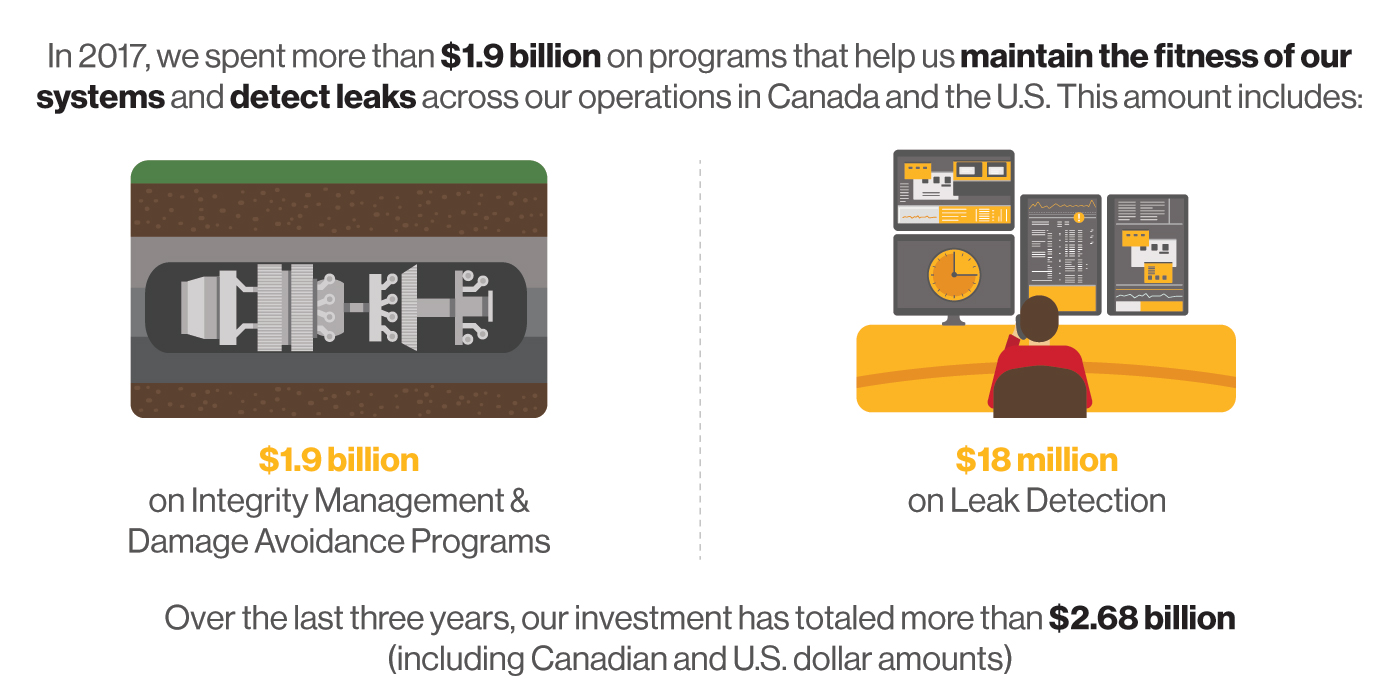
In 2017, we spent more than $1.9 billion on programs that help us maintain the fitness of our systems and detect leaks across our operations in Canada and the U.S. This amount includes $1.937 billion spent on maintaining system fitness through integrity management and damage avoidance programs* and $18 million spent on leak detection (Canadian dollar amounts). Over the last three years, our investment has totaled more than $2.68 billion (including Canadian and U.S. dollar amounts).
* In our Sustainability reports prior to this 2017 report, we did not include damage-avoidance spending in our total system-fitness expenditures.