Our activities with our stakeholders are governed by our core values of Integrity, Safety and Respect. Our Corporate Social Responsibility (CSR) Policy commits us to timely and meaningful engagement with all stakeholders through clear, honest and respectful interactions.
We have an integrated management system for stakeholder engagement that supports our multi-disciplinary and risk-based approach to managing the planning and execution of all of our stakeholder and Indigenous engagement, inclusion and communication activities.
The system is coordinated, systematized and scalable, and incorporates standardized processes, procedures, tools and templates to enhance the effectiveness and provide consistency in our approach across all of our projects and operations. It is based on leading industry practices and global benchmarking systems, and further advances accountability, documented reporting and continuous improvement.
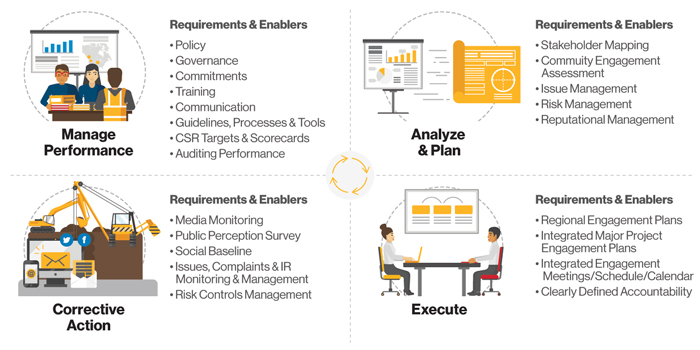
As shown in the diagram below, the system involves four stages—Analyze & Plan; Execute; Corrective Action; and Manage Performance—each of which has its own requirements and enablers.
Our stakeholders include the individuals and groups who live and work near—or who can affect or are affected by—our pipelines, power lines, operations and facilities. They include landowners, communities, governments, businesses, industry, non-government organizations, and regulators, as well as the individuals and organizations with whom we work to prepare for and respond to emergencies.
We also engage with Indigenous individuals and groups living near our projects and operations in Canada and the U.S. However, because, in both countries, Indigenous Peoples have distinct rights, we acknowledge that they are more than stakeholders and have adopted separate corporate policies and management systems and accountabilities for addressing Indigenous rights. We have distinct policies and management systems and accountabilities for addressing Indigenous rights and building community based relationships. We provide more information on our relationships with Indigenous Peoples in a Disclosure Paper, available here.
Through our Regional Engagement Plans (REPS), we work to develop and maintain constructive, meaningful and long-term stakeholder relationships.
Our REPs are based on a solid understanding of the regional environment and an effort to learn what matters most— the priorities, interests and concerns of our communities and stakeholders. Our REPs not only ensure that our engagement is ongoing and meaningful to stakeholders and regulators, but also serve as a foundation of stakeholder information when new projects are initiated in a region.
The REPs are operational documents that we review and update annually. Plans are developed and measured using a number of best practice processes, including: stakeholder identification, analysis and prioritization; issues, risk and reputation management; integrated governance; objective and target setting; and outcome reporting. In each REP, we identify stakeholder issues associated with our operations such that we can be highly accountable for—and responsive to—grievances, concerns, issues and requests, and can address stakeholder concerns in a proactive way.
Our REPs help us to manage our stakeholder relationships in each region and ensure coordination between our project planning and operations. They also help us consistently coordinate our stakeholder engagements across our company. Our multidisciplinary teams execute REPs in an integrated manner, incorporating their experience and learnings from community engagement.
As each of our new projects enters the planning stage, we create customized engagement plans for them. These Major Project Engagement Plans (MPEPs) are proactive, two-way communication and consultation strategies designed to help us: understand stakeholder issues; answer their questions and obtain their input on our project plans; improve our awareness of more broadly based community interests and perspectives; and make changes to our plans based on what we learn.
Our MPEPs involve identifying and prioritizing stakeholders, tailoring engagement methods according to stakeholder priority levels, identifying and analyzing issues and risks, and developing mitigation plans and processes to respond to issues and risks that might occur.
To ensure that our MPEP is effective and appropriate, we reach out to stakeholders and their communities to get to know them, the local environment, and the potential issues that currently exist. We conduct our outreach through surveys, focus groups and meetings with community members who represent the potentially affected region. We engage and communicate through newsletters, fact sheets, presentations, project update letters, telephone calls, emails, advertising, social media updates, and community events and open houses.
| Landowners and Tenants | Community Members | Emergency Responders | Government and Regulators |
| Town halls and open houses Face-to-face meetings Home and site visits Project newsletters and websites Social media Public awareness communications |
Town halls and open houses Face-to-face meetings Project newsletters and websites Social media Employee volunteer projects Partnerships with local and regional organizations Community investment and grant programs |
Face-to-face meetings Online emergency responder training Safe Community Grant Program Facility tours Emergency response tabletops and exercises |
Delivering and managing regulatory compliance Engagement on key public policy and legislative issues Involvement through industry groups Facility tours Face-to-face meetings |