Because Indigenous Peoples in Canada and the U.S. have distinct rights, Enbridge acknowledges that Indigenous Peoples are more than stakeholders and has adopted a separate corporate policy to ensure that our activities respect those rights. Our Indigenous Peoples Policy outlines the key principles that guide our engagement with Indigenous Nations and groups in areas in North America where our pipelines cross their lands.
We are implementing our Indigenous Peoples Policy through guidelines, practices and management systems that recognize the legal, regulatory and historic context on Indigenous rights and support best practices on Indigenous consultation and engagement across all of our projects and operations.
While we believe that building sustainable relationships with Indigenous Nations connects directly to each of our core values—Integrity, Safety and Respect—we also believe that it is integral to business success. Historically, Enbridge—like other companies with linear infrastructure projects—has pursued project-specific, limited-term capacity agreements or relationships with local Indigenous Nations. Today, we have come to more fully appreciate the value that building longer-term relationships can create for both the communities involved and our business. Depending on the nature of a project, elements of our Indigenous consultation and community engagement process can include:
Our approach to Indigenous consultation and engagement on Enbridge’s Line 3 Replacement Program in 2017–2018 provides the best real-time example of how our learning on Indigenous inclusion in energy infrastructure has evolved—and continues to evolve.
Enbridge’s Line 3 Replacement Program is the largest project in our history. It will replace 1,031 miles (1,660 kilometres) of existing aging pipeline and associated facilities on both side of the Canada-U.S. border with the newest and most advanced pipeline technology and provide improved capacity to support U.S. and Canadian demand for Canadian crude oil.
Our “L3R Program” also involves the most comprehensive program for Indigenous consultation and engagement in Enbridge’s history. At the direction of the federal regulatory agency in Canada responsible for pipelines – the National Energy Board (NEB) – Enbridge also consulted and engaged with over 150 different Indigenous groups as far away as 187 miles (300 kilometres) away from the existing pipeline right-of-way across the provinces of Alberta, Saskatchewan and Manitoba.
Significant Outcomes to Date
For more information on our approach to consultation and engagement on Enbridge’s Line 3 Replacement Program please see section 7 of our Discussion paper on Indigenous Rights and Relationships in North American Energy Infrastructure.
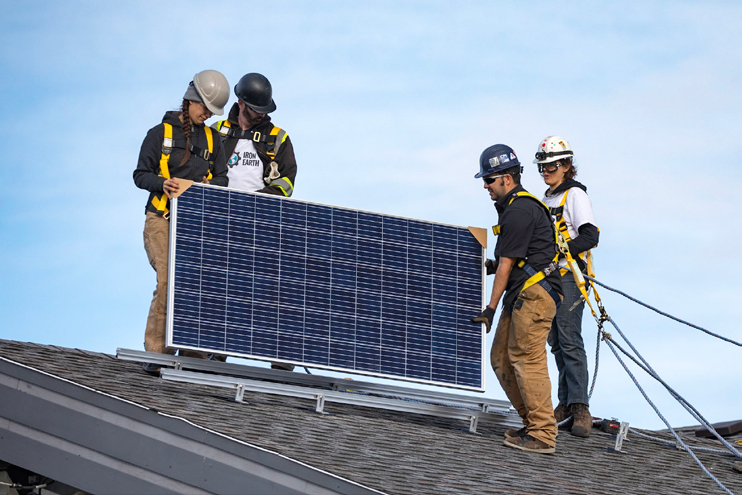
Above: Members of the Louis Bull Tribe, in central Alberta, and fellow graduates of the Iron & Earth solar skill program install solar panels on the roof of a community daycare facility in October 2017. Iron & Earth hopes to upskill 1,000 oil, gas and coal workers, as well as Indigenous community members, as solar specialists through hands-on installations.
Through our ongoing engagement with Indigenous communities, we know that many Indigenous communities are able to offer a skilled workforce as well as business management experience. With that in mind, we are advancing two initiatives within our Supply Chain Management function that aim to broaden Indigenous economic participation in our Line 3 Replacement Project through increased hiring of Indigenous workers by our construction contractors.
The first initiative involves agreements between Enbridge and Indigenous communities that prepare their members for construction employment opportunities and provide ongoing support during employment. In instances where these agreements are entered into, they will define employment targets and identify compensation to Indigenous communities for those services. A second, complementary initiative that we are moving forward with is the development of a web-based labour portal, which will allow even more communities to engage with our contractors. Working with a number of Indigenous communities to develop a database of potential community members with required skills, this web-based tool will enable us to identify and connect qualified Indigenous workers with our Line 3 Replacement Project construction contractors. In addition, we have engaged relevant craft trade unions to ensure that any qualified Indigenous workers that are identified through this process can become temporary union members during their employment on the Line 3 Replacement Project.
After Enbridge’s initial archeological work on our Line 10 Westover Segment Replacement Project identified multiple sites of interest within the proposed right-of-way, we reached out to three First Nations with archaeological affiliations across Southern Ontario and because of their potential interest in the archaeological assessment work being undertaken for the project.
Early in the project, Enbridge hired an archaeologist who participated in our engagement with the Six Nations of the Grand River, Haudenosaunee Development Institute and Mississaugas of the New Credit First Nation to ensure that archeological input was included in our project planning. The extensive consultation process led to the re-route of the project around two archaeological sites within the corridor approved by the regulator. We also hired First Nations monitors who were present throughout the archeological work and reported directly to their respective communities to ensure timely updates were provided and protection measures were in place. Enbridge understands archaeological sites have a strong spiritual and cultural significance to Indigenous communities. As such, we provided capacity funding to provide resources for experts to analyze reports and findings, as well as to discuss mitigation measures. In addition to their involvement in the archaeological work on the project, members of the First Nations participated in daily environmental site visits to multiple project locations, which they identified as specific areas of interest during the construction phase. The purpose of these site visits was to demonstrate the mitigation measures implemented by Enbridge but they were also an opportunity for Enbridge to better understand the unique interests and needs of the First Nations.