



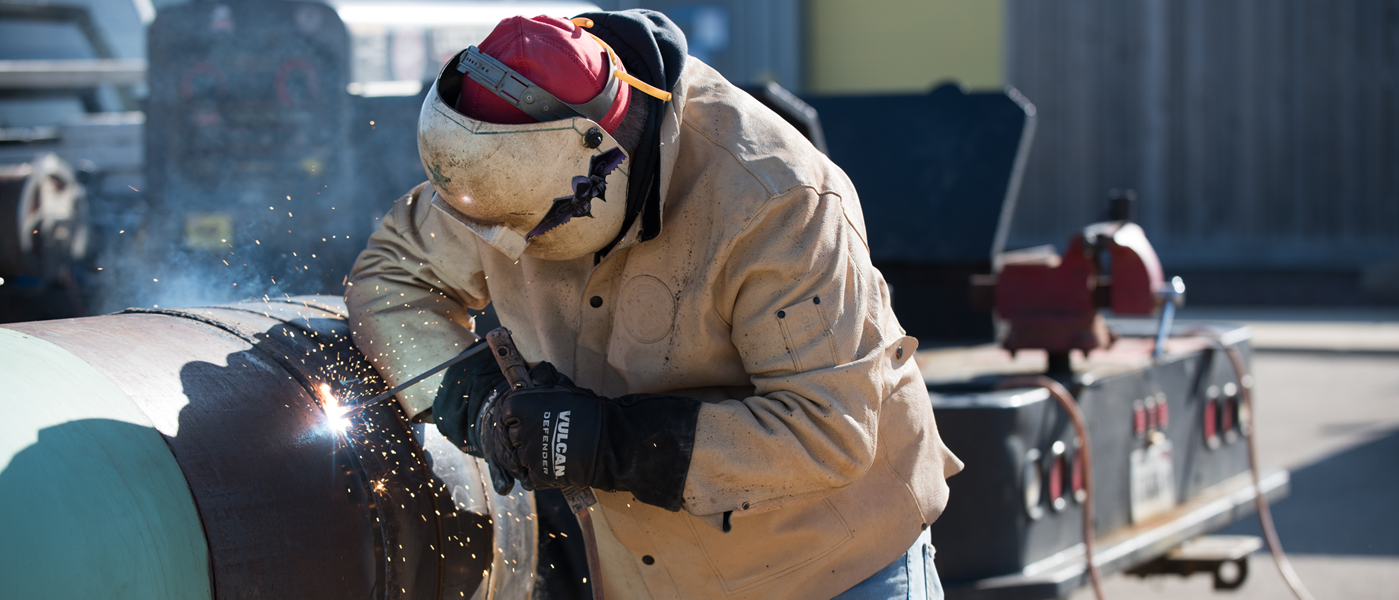
Work is picking up at the construction yards along the route of the Line 5 Wisconsin Segment Relocation Project. Trees hand-felled earlier this spring on the right of way will soon be collected to make way for construction activities to begin.
The project will build a new, roughly 41-mile segment of pipeline around the Bad River Reservation, across portions of Bayfield, Ashland and Iron counties. Crews will follow hundreds of permit conditions designed to avoid and minimize construction impacts.
This is the most studied pipeline project in Wisconsin’s history, with “over-and-above” rigor put into planning. It has been years in the making.
Line 5 Wisconsin Timeline
| Date | Activity |
|---|---|
| 1953 | Line 5 is built to provide year-round energy security and take oil tankers off the Great Lakes. |
| 1973 | Line 5 easements are renewed for 20 years by the Bad River Band and the Bureau of Indian Affairs (BIA). |
| 1992 | The Bad River Band and Enbridge sign a 50-year renewal agreement, allowing Line 5 to operate on the Reservation on Band-owned trust property until 2043. Bad River Tribal Council votes to approve the agreement. |
| 1992 to 2013 | The Band acquires partial interest in additional parcels of land on the Reservation amounting to 2.3 miles of Line 5 right-of-way. Despite repeated meetings and offers from Enbridge, the Band refuses to renew easements on these 12 parcels. |
| 2017 | The Band’s government passes a resolution stating it would not renew the easements on the 2.3 miles. Enbridge and the Band entered into two years of confidential mediation. |
| 2019 | The Band’s government terminates mediation without warning, breaching the terms of the mediation agreement. The Band files a federal lawsuit to force Line 5 off the Reservation. |
| 2019 | Tribal cultural resources survey is conducted of the entire proposed relocation route by an Ojibwe-owned company employing local Tribal members. Dozens of environmental studies and surveys continue, including water quality analysis and thousands of computer models which inform project design and construction plans. |
| 2020 | Enbridge files state and federal applications to relocate Line 5 off the Bad River Reservation. |
| 2020, 2021, 2022, 2023, 2024 | Enbridge proposes more than a dozen projects to address erosion of the bank of the Bad River near Line 5, known as the Meander. The Band does not approve any of Enbridge’s erosion prevention proposals. |
| 2019 to 2024 | Enbridge holds dozens of information sessions and opens a new office in Ashland in April 2024, continuing to host over 100 public informational events. |
| 2023 | Order is issued in federal lawsuit. Both the Bad River Band and Enbridge appeal various parts of that decision. Later that year legal counsel for Enbridge and the Bad River Band present oral arguments before the United States Court of Appeals for the Seventh Circuit. We await a decision. |
| 2024 | Enbridge offers Bad River Band $80 million as part of a comprehensive agreement. |
| 2024 | Bad River Tribal Council approves a Line 5 check valve installation on the Reservation, which is successfully installed by Enbridge teams. |
| 2024 | State permits for the relocation project are issued by the Wisconsin Department of Natural Resources (DNR) after a thorough four-plus-year-review. Ten specialized DNR programs examine the project’s environmental effects and roughly 100 staff and consultants contribute to a permitting file that now exceeds 100,000 pages. All reviews confirm that any project construction impacts will be temporary and isolated, have no measurable effect on water quality, and would not violate water quality standards. |
| December 2024 | State permits are challenged by Bad River Band and others. |
| January 2025 | Bad River Tribal Council approves Log Jack Project to reinforce the bank of the Bad River near Line 5. Hundreds of temporary erosion control devices (“log jacks”) are successfully placed by Enbridge contractors during the following month. |
| 2025 | Relocation project permits go through a year-long contested case process led by an Administrative Law Judge (ALJ). |
| October 2025 | U.S. Army Corps of Engineers (USACE) issues an Initial Proffered Permit (IPP). |
| 2025 | Bad River Band challenges USACE permits in D.C. federal court. |
| February 2026 | ALJ Angela Chaput Foy issues a decision upholding state permits allowing construction to move forward. The Bad River Band and others file suit to challenge and stay the ALJ’s decision; case moves forward in Iron County District Court. |
| February 2026 | Final federal permit is issued by USACE. First phase of construction begins. |
| February 2026 | Chief Justice Anderson (in Iron County Circuit Court) denies Bad River Band’s request for an ex parte stay of construction. Work continues on the project. |
| February 2026 | Judge Conley grants Enbridge’s motion to stay the June 2026 shutdown order until the parties’ appeals are resolved by the Seventh Circuit Court of Appeals. |
| March 2026 | Crews successfully hand-fell trees along the entire 41-mile relocation route with zero incidents. |
| April 2026 | Chief Justice Anderson (in Iron County Circuit Court) hears arguments for and against a stay of construction. Work continues as we await a decision. |
| April 2026 | Bad River Band voluntarily withdraws its complaint challenging the USACE IPP, then refiles a new complaint in D.C Federal Circuit Court challenging the final USACE permit. |
| May 2026 | The success of the first phase of construction sets the tone as preparations ramp up for the next phase of work. At its peak, the project will employ roughly 700 highly trained, skilled union workers—following hundreds of strict environmental permit conditions. |
An economic impact study for the project found it will ultimately add $135 million to Wisconsin’s economic output and increase state tax revenues by $6.4 million. It’s estimated $46 million will be spent specifically contracting with Native-owned businesses, in Tribal communities, and on training and hiring Native American workers.