Incoming Enbridge CEO Michele Harradence tells Toronto business audience that turning momentum into investment, projects and execution will be key to Canada’s next chapter of growth and prosperity
“The strongest signal Canada can send investors is not another statement about our potential. It’s a project that succeeds.”
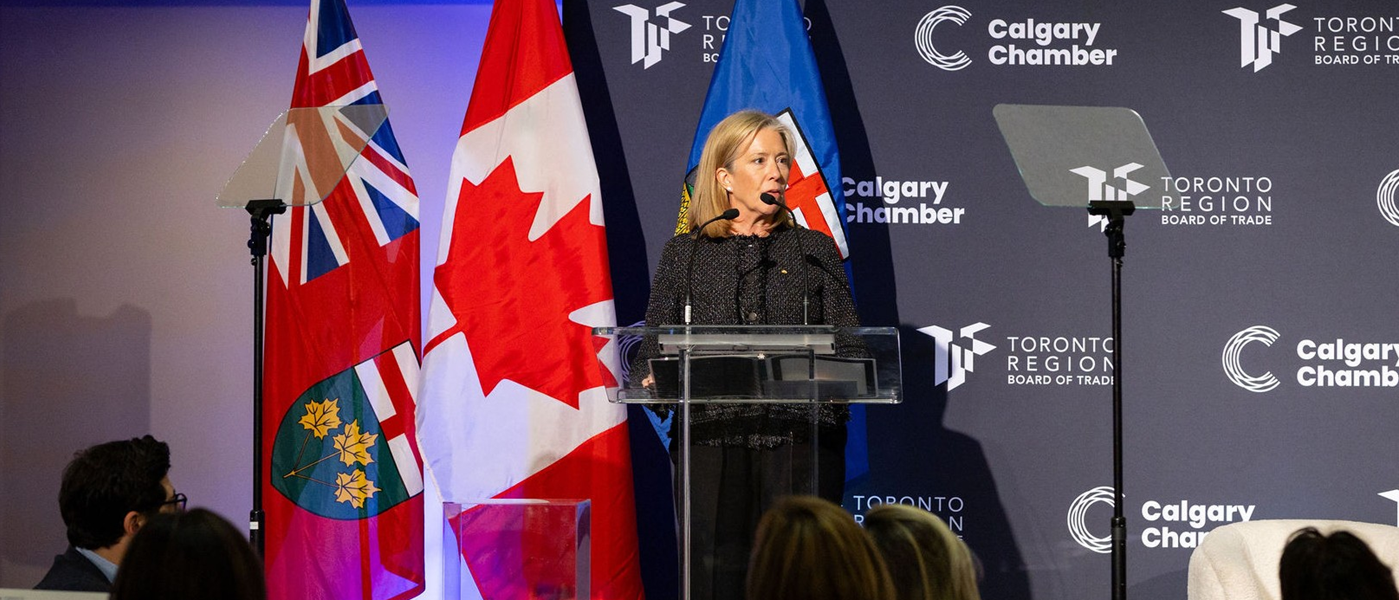
That was the message Michele Harradence, Enbridge’s incoming President and Chief Executive Officer, delivered to business, government and industry leaders in Toronto on Monday.
Ms. Harradence delivered the closing address at Stronger Together: Alberta, Ontario and Canada’s Growth Agenda, an event exploring the ways collaboration between two of Canada’s largest provincial economies can strengthen the country’s competitiveness.
Canada’s conversation has increasingly shifted from whether the country should build to what it needs to build, how quickly projects can move forward, and how to attract the capital required to make them happen, she said.
Monday’s event, co-hosted by the Toronto Region Board of Trade and the Calgary Chamber, also drew speakers including former Canadian Prime Minister Stephen Harper, Ontario Premier Doug Ford and Alberta Premier Danielle Smith.
"The real test is whether ambition becomes investment, whether investment becomes projects, and whether those projects get built."
Michele Harradence
Incoming Enbridge President and CEO,
speaking at the Stronger Together: Alberta, Ontario and Canada’s Growth Agenda event
For investors, the questions are practical: Can a project be approved? How long will it take? Are the rules clear, predictable and durable? Can it connect to customers and markets? And can it compete for capital around the world?
“These are not abstract policy questions,” Ms. Harradence said. “They determine where investment goes and where growth happens.”
Ms. Harradence pointed to progress on several priorities identified through Build Canada Now, an initiative launched by leaders from across Canada’s energy sector in March 2025 to help create conditions that give investors greater confidence in choosing Canada.
Those developments include the creation of the federal Major Projects Office, efforts to establish clearer timelines for major-project reviews, measures to improve Canada’s investment climate, and expanded opportunities for Indigenous communities to participate as project owners.
“Are we finished? No. But the direction is clear,” Ms. Harradence said. “When governments align around investment and execution, capital notices.”
The real measure of progress, she added, will be how many businesses choose to invest in Canada, how many projects reach a final investment decision and, ultimately, how many get built.
“Government creates investable conditions,” she said. “Industry turns those conditions into projects. And investors decide whether Canada has earned their capital.”
Canada has seen what becomes possible when those conditions come together.
Following the landmark Leduc oil discovery in 1947, Alberta had a new resource opportunity, while Ontario had refineries, industrial capability and customers. The company that became Enbridge was created to connect them, and by the early 1950s, Alberta oil was flowing to Sarnia.
“Alberta’s resource opportunity became an Ontario industrial opportunity . . . and a Canadian growth story,” Ms. Harradence said. “The lesson is that Canada creates value when we connect what different parts of the country do exceptionally well.”
That same principle is visible in Ontario today.
Enbridge Gas, North America’s largest natural gas utility franchise by both customer count and delivery volume, invested roughly C$350 million to expand natural gas infrastructure in the Leamington and Kingsville area. That expansion is supporting customer growth in one of North America’s largest greenhouse clusters.
That expansion is helping unlock an estimated C$4.5 billion in downstream economic activity.
“The full value of infrastructure is not simply the pipe in the ground,” she said. “It’s what other people can build because the capacity is there.”
That multiplier demonstrates why building the energy system required for future economic growth will be one of Canada’s greatest opportunities over the next decade.
Canada will need:
- more energy for manufacturing, critical minerals and industrial development.
- more electricity for electrification, artificial intelligence and data centers.
- reliable natural gas for homes, businesses and industry.
- infrastructure connecting Canadian energy to customers at home and around the world.
Alberta and Ontario have complementary strengths that can help Canada meet this demand and strengthen its competitiveness.
 TOP AND ABOVE PHOTOS: Incoming Enbridge President and CEO Michele Harradence delivered the closing address at Stronger Together: Alberta, Ontario and Canada’s Growth Agenda, an event exploring the ways collaboration between two of Canada’s largest provincial economies can strengthen the country’s competitiveness.
“These are not competing opportunities,” Ms. Harradence said. “Canada needs an integrated, all-of-the-above energy system with the capacity, diversity and flexibility to support them together.”
As she prepares to become Enbridge President and CEO on Jan. 1, Ms. Harradence outlined three Canadian business priorities:
- build capacity before constraints cost Canada investment
- create clear, durable and competitive conditions for capital
- execute
That requires governments to continue creating the conditions for investment, Alberta and Ontario to build on their complementary strengths, and businesses to bring forward credible projects, build partnerships early and deliver them safely and responsibly.
“Canada," she said, “Let’s. Keep. Going.”