Enbridge is proposing work to optimize its Line 26 pipeline. Known as the Line 26 Optimization Project, this work would enhance operation of the pipeline and create a new connection into an Energy Transfer (ET) facility, allowing access to the Dakota Access Pipeline.
This work could improve energy security and help ensure stable energy prices for consumers.
Potential Project Overview
This project would enhance the operation and transportation capabilities of the Line 26 pipeline by making the following changes:
Flow Direction
The Project would reverse the flow of product in the Line 26 pipeline, resulting in a north-to-south flow direction.
Additional Pipeline Connectivity
To connect Line 26 pipeline to ET, Enbridge would use parts of the existing Line 26 pipeline, along with the addition of a new pipe. This would involve Enbridge:
- Continuing to operate the existing 16-inch pipeline from the Cromer Terminal in Manitoba (MB) to the Steelman pump station in Saskatchewan (SK).
- Constructing a new 24-inch pipeline segment to replace the existing 12-inch pipeline starting at the Steelman pump station. This new 24-inch pipeline segment would cross the Canada/U.S. border and be constructed along an optimized route to connect to the ET Ramberg Terminal in North Dakota (ND). It would be approximately 128 kilometers (80 miles) in length of which approximately 32 kilometers (20 miles) would be in SK and approximately 96 kilometers (60 miles) would be in ND.
- Decommissioning or deactivating the existing 12-inch pipeline from the Steelman Station to approximately 800 meters (0.5 miles) south of the Canada/U.S. border and abandoning the remaining 12-inch pipeline to the Berthold Terminal in ND.
Pump Station Modifications
In conjunction with the Project’s pipeline optimization work, new pump stations would be required along with modifications to existing pump stations. This work would include:
- A new initiating pump station located within Enbridge’s existing Cromer Terminal in MB
- A new midpoint pump station located near Alida, SK
- Equipment modifications at Enbridge’s existing Steelman pump station in SK
Line 26 Potential Routing
The route of the new segment of the Line 26 pipeline is still being determined, and Enbridge is interested in working with landowners, communities, Tribal Nations, First Nations and Métis governments to assess the best potential route for this pipeline.
In Canada, routing is expected to follow the existing Line 26 pipeline to minimize disruptions to landowners, area residents, and the environment. This section of pipe is anticipated to be approximately 32 kilometers (~20 miles) in length.
In the U.S., the new segment of pipe is expected to follow the existing Line 26 pipeline up to a new valve on the south side of the Canada/U.S. border, at which point a new optimized route would be used to connect directly to the ET Ramberg Terminal in ND. This section of pipe is anticipated to be about 60 miles (~95 km) in length.




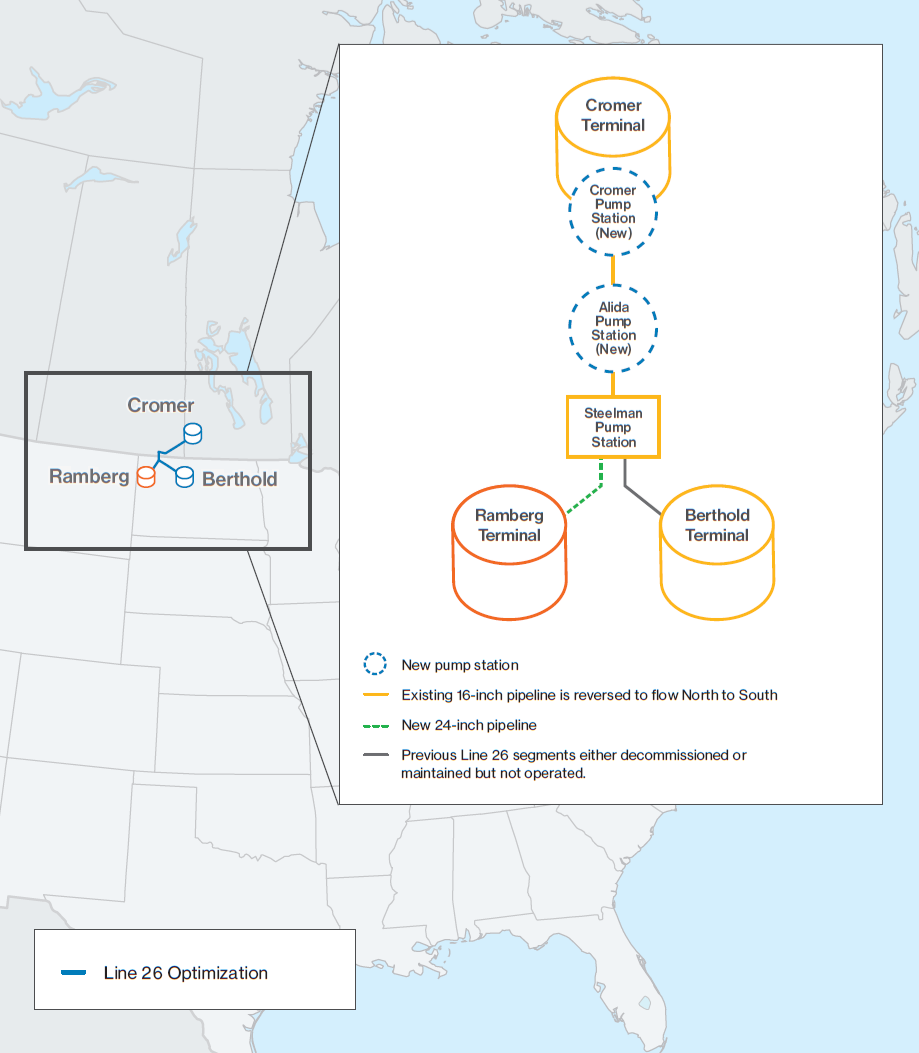 (click image to enlarge project map)