



Drill promotes safety, preparedness
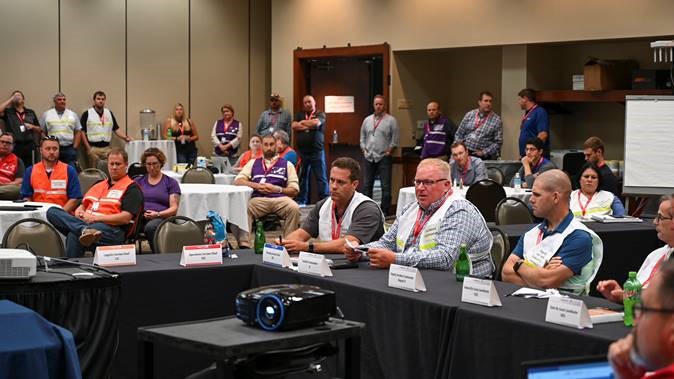 The July 15 exercise involved more than a dozen local, state and federal agencies, along with employees of Enbridge.
First responders, regulatory agencies, Enbridge work together
July 28, 2021
In many aspects, the best defense often is a proactive offense.
Such is the case with enhancing the coordination among the dozens of agencies that would respond to an incident, such as a pipeline release or product spill, involving Michigan’s waterways.
Approximately 250 representatives from federal, regional and local response and regulatory agencies participated in the recent Stockbridge Full-scale Emergency Preparedness Exercise. Held in Livingston County, MI, in proximity to Enbridge’s Stockbridge Terminal, the July 15 exercise incorporated real-life exercises and scenarios.
“The drill exemplifies Enbridge’s safety commitment to action,” said Bob Lehto, Enbridge’s operations manager for the northern Michigan area.
“Assessing how well we deliver a timely, coordinated response to an incident is an essential part of our proactive approach to keeping communities safe and minimizing impact to the environment. We take these drills seriously and so do first responders and our regulator.”
Over the last 11 years, Enbridge has invested more than $8 billion on maintenance, inspection and leak detection across its crude-oil pipeline system, leading to record safety performance for the largest pipeline operator across North America. It also has hosted and participated in dozens of large-scale response drills.
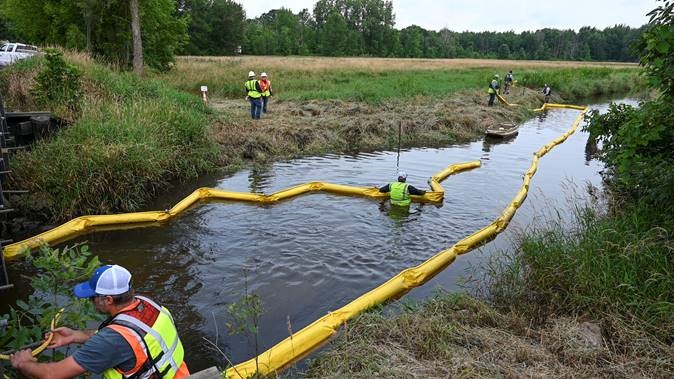 Workers deployed inflatable containment boom during the full-scale exercise. Resources like this are available to use rapidly if a real event would occur.
Exercise promotes safety and coordinated response
“After participating in an exercise like this, I feel even more confident that Enbridge and the agency partners are even more prepared to fully and quickly respond to a release near our community,” said Stockbridge Fire Chief Robert Feig.
Part of the day also included working under a Unified Command (UC), required when incidents involve multiple agencies and responders.
“Clearly delineating the roles and actions is imperative to addressing the incident safely and responsively,” explained Lehto. “The Unified Command establishes the structured framework under which we operate to maximize safe, efficient and successful response. UC is used all over the country when it comes to dealing with serious issues like hurricanes, fires in the West, the recent building collapse in Florida or any emergency situation that calls for a multi-level response.”
The U.S. Environmental Protection Agency (USEPA), Michigan Department of Environment, Great Lakes, and Energy (EGLE) and Enbridge comprised the UC for the full-scale drill.
Regionally, responders and other representatives from the City of East Lansing; Village of Fowlerville; City of Howell, and Ingham, Jackson, Livingston, and Shiawassee counties, also participated in the day’s events.
In addition to the USEPA, representatives from the U.S. Department of Transportation Pipeline Hazardous Materials Safety Administration (PHMSA), the National Oceanic and Atmospheric Administration (NOAA); and the U.S. Fish & Wildlife Service were among the federal agencies that participated, as did the Canada Energy Regulator.