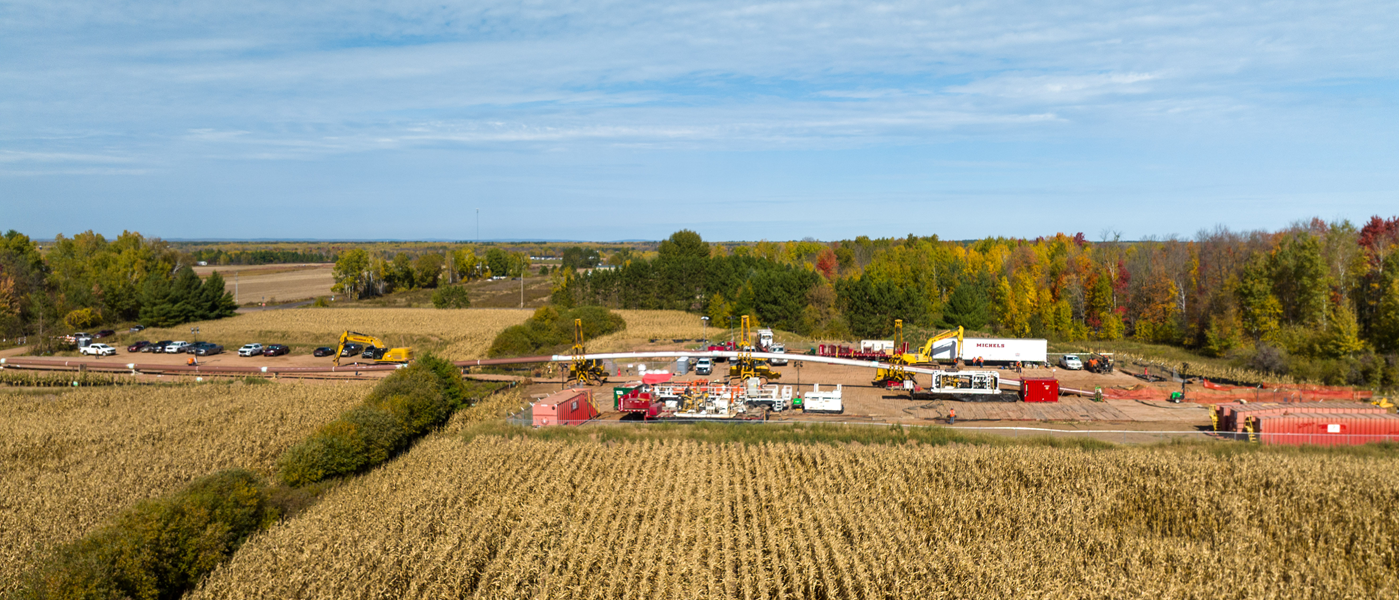
With major pipeline construction largely complete, crews are increasingly turning their attention to cleanup, restoration and finishing work across northern Wisconsin
For months, signs of construction have been hard to miss across northern Wisconsin.
Work trucks have traveled local roads. Heavy equipment has moved through fields and along the right-of-way. Crews have worked near rivers and streams that local residents know well.
Now, the Line 5 Wisconsin Segment Relocation Project is beginning to look different.
Major phases of pipeline construction are complete—including clearing, grading, welding, coating, digging the trench, lowering the pipe into place, and backfilling. Utility tie-in work is about 93% complete, while cleanup and restoration is approximately 67% complete.
In other words, across more stretches of the project, the work is shifting from putting pipe in the ground to restoring the landscape.
Crews are still busy, including familiar trades like equipment operators, laborers, Teamsters, and welders, as well as environmental specialists and inspectors. But some of the project's most interesting work has taken place where few people see it—deep underground, with horizontal directional drilling.
Going beneath northern Wisconsin’s rivers
In northern Wisconsin, rivers and streams aren't simply lines on a map. They're places people fish, paddle, hunt near and explore with their families.
They also pose unique challenges when building a pipeline.
At certain rivers, creeks, roads and other complex crossings, crews use a technique called horizontal directional drilling, or HDD, to install the pipeline underground without excavating a trench directly across the surface.
“Enbridge is always looking out for the right process to use to build a pipeline,” said Adam Erickson, a technical manager of projects with Enbridge. “In many cases where we see an obstacle, like a waterway, we choose to do an HDD to minimize impacts.”
So how do you drill beneath a river?
The process is a little like threading a needle underground, except the “thread” is a long section of steel pipe.
Crews first set up drilling equipment on one side of the crossing and drill a relatively small pilot hole into the ground. Instead of traveling straight across, the drill follows a carefully planned parabolic path, gradually moving deeper underground, passing beneath the obstacle and then curving back toward the surface on the other side.
That first hole establishes the route.
Crews then enlarge the underground opening until it is large enough to accommodate the pipeline. At the same time, workers on the other side of the crossing weld individual pieces of pipe together into one long section and complete inspections and other preparations.
Once everything is ready, the pipeline is connected to the drilling equipment and carefully pulled through the underground path.
It's a process where patience matters.
The idea is simple—steady progress, careful monitoring and inspections are more important than completing a crossing quickly.
What's in the drilling fluid?
HDD construction also comes with a term that may sound more mysterious than it is—drilling fluid.
For this work, the drilling fluid is approximately 96% water and 4% bentonite, a naturally occurring clay.
The mixture helps lubricate and stabilize the underground pathway as drilling equipment moves through the soil and, later, as the pipeline is pulled into place. The bentonite used for this work is approved for this application by the Wisconsin Department of Natural Resources (DNR).
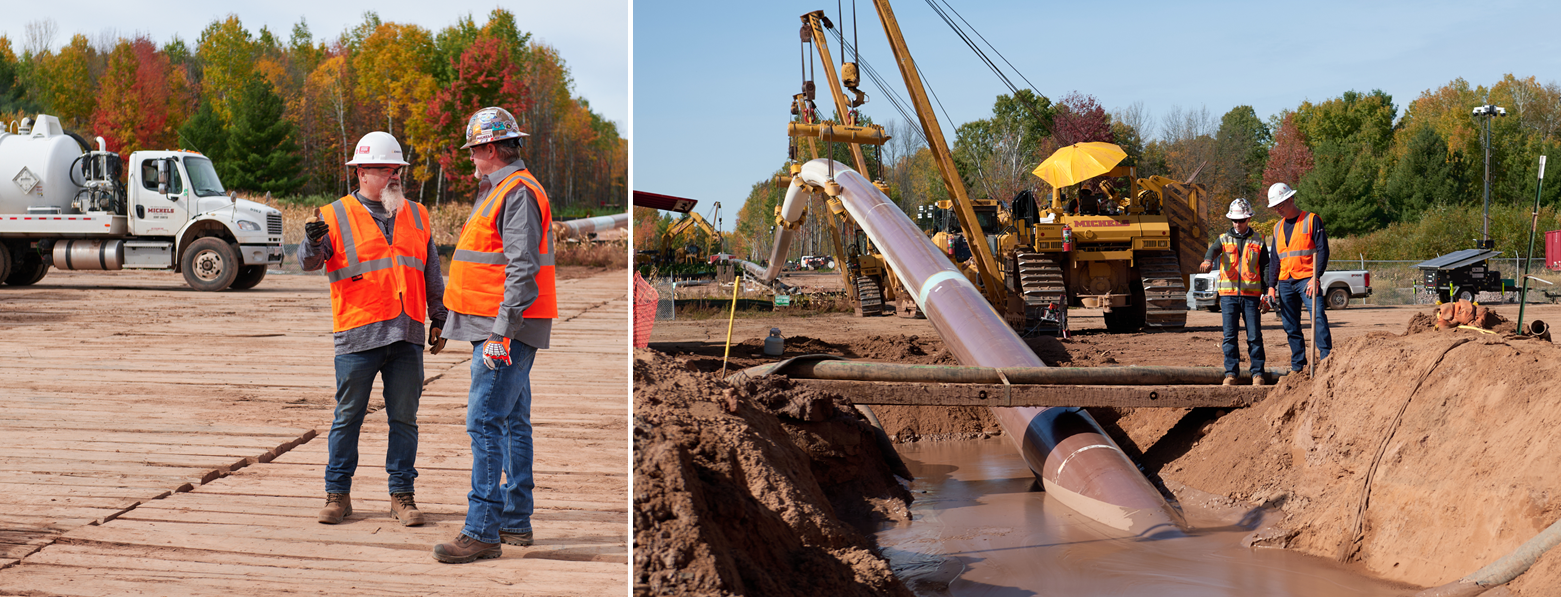 TOP PHOTO: Horizontal directional drilling helps install pipe beneath waterways, roads and other crossings. ABOVE LEFT: Careful planning, specialized teams, and focused oversight are all part of the HDD process on the Line 5 Wisconsin Segment Relocation Project. ABOVE RIGHT: Going under identified crossings is designed to reduce environmental and other surface impacts to waterways and roads.
“It’s hard to comprehend that we're pulling that pipe under the ground,” Erickson said. “When we actually explain the process, that the fluid that we use is a mined mineral and water, and that’s it, a lot of people find it fascinating.”
Familiar waterways mark major milestones
For people who live in the area, many of the names on the project’s list of completed crossings are familiar ones.
All 12 planned HDD crossings are now complete. They include crossings at the Bad River, White River, Brunsweiler River, Potato River, Tyler Forks, Silver Creek, Billy Creek, Krause Creek, Deer Creek, Trout Brook and Vaughn Creek, and under Highway 13.
Completing those crossings represents a significant milestone for a project.
More than the crew running the drill
An HDD operation involves far more people than the workers controlling the drill.
In addition to construction crews, the project team includes inspection personnel, a dedicated HDD inspector, environmental inspectors and Tribal monitors.
That oversight continues as the work moves into its next phase.
“All the people who work on HDDs care about the environment, love the outdoors, and we care about what we do,” said Bobby Holmes, lead HDD inspector with Enbridge.
In northern Wisconsin, that connection is especially meaningful. The rivers, forests and streams surrounding the project aren’t abstract features on an engineering plan. They’re part of the communities where people live, work, fish, hunt and spend time outdoors.
2,244 welds later, the work is changing
The numbers tell the story of just how far construction has progressed on the Line 5 Wisconsin Segment Relocation Project
Crews have completed 2,244 mainline welds, bringing mainline welding to 100%. Clearing, grading, stringing, coating, ditching, lowering-in and backfilling are also complete.
There will still be construction vehicles, equipment and crews in the area as the remaining work continues. But with the major underground crossings complete and most pipeline installation behind them, the view along the project route should continue to change.
The next chapter is increasingly happening above ground—cleaning up work areas, completing final grading and restoring the northern Wisconsin landscape.