New Mi’kmawey Debert Cultural Centre in Nova Scotia preparing for the return of repatriated ancestral collections
In 1930 and 1931, American anthropologist Frederick Johnson visited seven Mi’kmaw communities in Nova Scotia and Newfoundland.
He listened to stories, collected materials and took more than 200 photographs in search of ethnological information.
More than 1,000 of these cultural belongings—including an authentic wikuom dwelling built by Mi’kmaw Christopher Morris—are now in the hands of the National Museum of the American Indian (NMAI), Smithsonian, in Washington, D.C.
It’s time for them to come home.
Since late 2002, the Mi’kmawey Debert Elders’ Advisory Council, made up of representatives of provincial Mi’kmaw communities, have been preparing for the return of their ancestral collections from NMAI and other institutions. Guided by the desire to share their 13,000-year history with the world, the Mi’kmawey Debert Cultural Centre (MDCC) project was born.
“We want to ensure the centre accomplishes the overall goals of the Elders,” explains MDCC executive director Tim Bernard of the Millbrook First Nation. “The three guiding goals are to share our stories, to protect our past and to explore our histories.”
Bernard has been involved in planning the centre for more than 25 years. Much of that lead-time has been devoted to relationship-building with the institutions that hold Mi’kmaw collections. After decades of meticulous planning, the groundbreaking will take place this summer in Debert, Nova Scotia, near the city of Truro in the middle of the province. The centre’s doors are expected to open in the fall of 2028.
When Enbridge learned of MDCC’s efforts to repatriate their belongings, we contributed a $10,000 grant to support that important work. The repatriation of Indigenous cultural items is a key component of the Truth and Reconciliation Commission of Canada's (TRC) 94 Calls to Action.
It is also central to our Indigenous Reconciliation Action Plan (IRAP), and IRAP Refresh, which uphold our long-held commitment to strengthening relationships with Indigenous communities across North America and advancing reconciliation.
“It gives me goosebumps,” Bernard says, of connecting people to their past through lost belongings and photographs.
For some community members, it’s the first time they are seeing images of their family, notes Bernard.
“Life hasn’t been easy for community members and for communities,” he continues, citing residential schools and loss of traditional lands as some of the devastating hardships Mi’kmaq have endured. “The photos and the response to them show how resilient the people are.”
Once on display in the centre, the ancestral collections will help recount Mi'kmaw stories from the communities’ point of view.
“Our stories have been told from other perspectives, and, I think, this failed us early on, not being the writers of our story,” Bernard says. “We will get the opportunity to share Mi’kmaw culture, heritage, language and history from a Mi’kmaw perspective in a safe place.
“We invite the entire world to come and see us,” he adds. “We’re still here, collecting the pieces and bringing the story forward.”
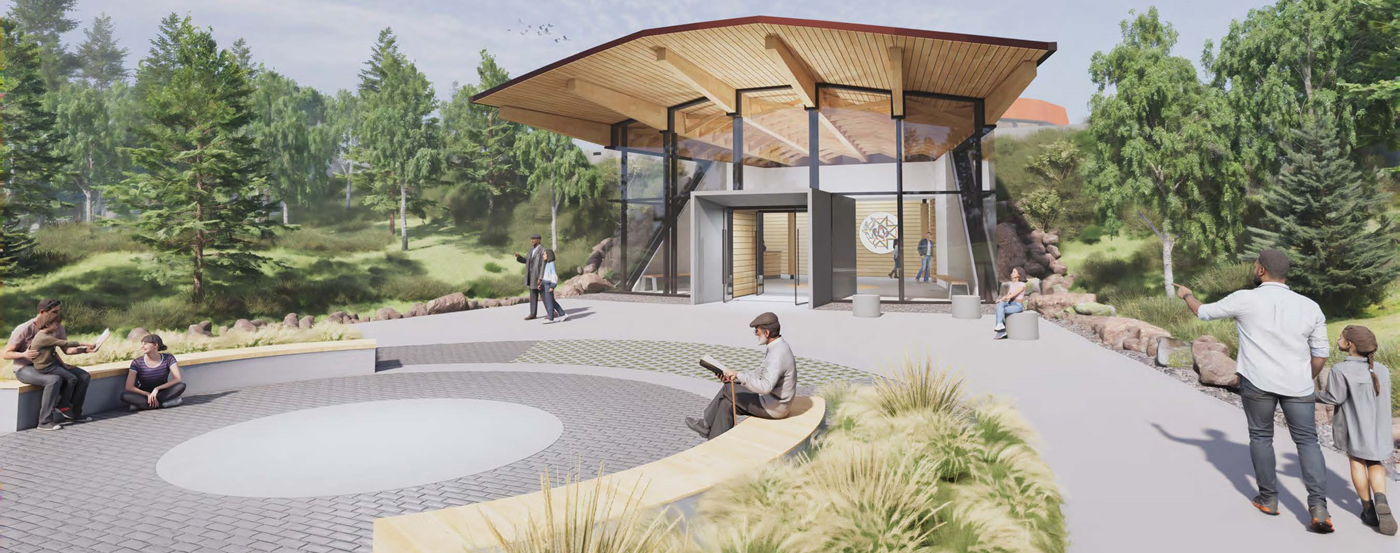
(TOP AND ABOVE PHOTOS: Artist renderings of the future Mi'kmawey Debert Cultural Centre in Truro, Nova Scotia.)