



Michigan, region benefit from energy infrastructure built to last
Line 5 remains a dependable, safe source of energy
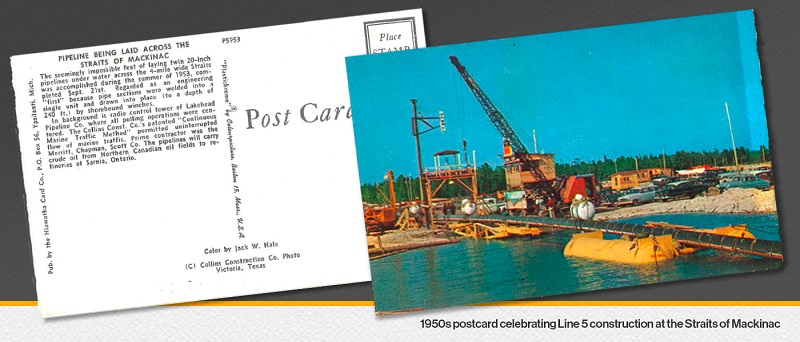
Spectators gathered on the shorelines of the Upper and Lower Peninsulas in 1953 to witness Enbridge placing Line 5 into service.
A year later, construction on the Mackinac Bridge, also known as the Mighty Mac, took place.
Many called the two feats “engineering marvels.”
The dual pipelines lay on the lakebed, just west of the Might Mac. Built to last, Enbridge maintains and inspects Line 5 regularly, helping it to stand the test of time and continuing to prove why it earned that designation.
To the benefit of Michigan and four other states, as well as Canada’s two largest provinces, Line 5 continues to operate safely, reliably and in full compliance with the federal regulations that govern it. Following evaluations conducted as recently as 2020, the federal pipeline regulator, the U.S. Pipeline Hazardous Materials and Safety Administration, consistently has determined the condition and operation of Line 5 are safe.
Staying power
“This is a significant piece of energy infrastructure designed to stand the test of time, and it has,” said Mike Moeller, director of operations for Enbridge Great Lakes region. “Line 5 does far more than help heat homes and businesses. It provides the light crude oil refineries in Michigan, Ohio and Ontario turn into more than 6,000 products on which people depend. From medicines to eyeglasses, to phones, computers, cars, bicycles, and solar panels, Line 5 helps make life possible.”
While Line 5 continues to operate safely, Enbridge is focusing on the Great Lakes Tunnel Project. The Great Lakes Tunnel Project will house a replacement section of Line 5 in the Straits to help ensure the continued safe and reliable transportation of energy to the area.
“We are committed to providing affordable energy to Michigan and the region,” stressed Moeller. “For the millions who rely on Line 5 every day, the Great Lakes Tunnel Project will make this safe pipeline even safer.”
Investing in safety, technology helps maintains the pipeline
Since 2018 alone, Enbridge has invested more than $100 million on improvements to Line 5, including a suite of successful safety measures. Similarly, Enbridge is making a private investment of more than $500 million to construct the Great Lakes Tunnel Project.
“Along with being the best long-term solution to safeguard the Great Lakes while keeping the energy flowing, construction of the Great Lakes Tunnel exemplifies our ongoing commitment to a healthy energy future,” said Moeller. “The Great Lakes Tunnel Project again will showcase how technological advancements can advance protection of the Great Lakes waters and the people who use them while maximizing the region’s ability to continue to receive safely energy from Line 5.”
Achieving a healthy energy future
In addition to technology and construction of the Great Lakes Tunnel, part of Enbridge’s healthy energy future includes continuing investments in renewable energy. The Company recently shared its plans to reach net-zero greenhouse gas emissions by 2050. Enbridge is on track to reach its interim target to reduce throughout its operations the intensity of greenhouse gas emissions 35 percent by 2030.
Enbridge’s continued safe operation of Line 5 and its investment in a diverse energy mix adds to the puzzlement of why the State of Michigan continues its efforts to force a potential shutdown of the dual pipelines in the Straits.
“This is a critical time for the people of Michigan and the regional economy,” said Moeller. “Up to 10 regional refineries count on the oil transported by Line 5. Without Line 5, people in Michigan and the region will see higher prices for fuel in the future. We need to focus on keeping the energy flowing to those who rely on it, while protecting the waters of the Great Lakes. The Great Lakes Tunnel Project is the commonsense solution.”
Moeller shared that Enbridge welcomes an open dialogue with State officials to resolve differences and do what is best for the region’s energy future.
The State and Enbridge are working with a third-party mediator. Those mediation discussions continue.